Mushrooms are nature’s recyclers, fast growers, nutritional powerhouses, and accessible to anyone — regardless of land, capital, or formal education.
Mushrooms sit at a rare intersection — low cost to cultivate, high nutritional value, fast yield cycles, no land ownership required, and environmentally restorative rather than extractive. For rural women with limited capital and space, that combination is transformative.
Mushrooms are nature’s recyclers — breaking down organic matter into rich, fertile soil. This natural ability makes cultivation a sustainable practice, reducing waste and promoting eco-friendly agricultural methods. You’re not depleting the land. You’re improving it.
Every figure here represents a real woman, a real village, a real change in economic circumstance. These are not projections.
Mushrooms don't deplete — they restore
Mushrooms are nature’s recyclers. They break down organic matter — crop waste, sawdust, straw — and convert it into rich, fertile substrate. Cultivation reduces agricultural waste rather than creating it. When the growing cycle ends, the spent substrate becomes compost that returns nutrients to the soil. It is one of the few agricultural practices that is net-positive for the land it uses.
A real income from a very small space
A single growing kit produces a meaningful yield in 3–4 weeks. Multiple kits mean multiple harvest cycles — and with a guaranteed buyback price, the income is predictable. No market risk. No middlemen. No negotiation at the farm gate.
No land, no capital, no barrier
Mushroom cultivation requires no agricultural land, no heavy equipment, no literacy, and no prior farming experience. It can be done in a corner of a home. This makes it uniquely accessible to women who have been excluded from every other form of economic participation.
Fast returns, repeatable cycles
First harvest in 3–4 weeks. Multiple flushes from a single kit. Year-round cultivation without seasonal dependency. The feedback loop is fast enough to build skill and confidence quickly — critical for first-time growers.
Not subject to seasonal limits
Unlike most agricultural crops, mushrooms can be grown year-round in controlled indoor conditions. No monsoon dependency. No seasonal income gap. Consistent production means consistent income — which is what financial stability actually requires.
Growing on waste, not resources
Mushrooms grow on agricultural by-products — rice straw, wheat straw, sawdust — that would otherwise be burned or discarded. This reduces stubble burning (a major air quality issue in UP), creates no chemical runoff, and uses minimal water.
Grant bodies and CSR teams often need more than a summary. Here’s the detailed case — environmental, economic, social, and nutritional — for mushroom cultivation as a vehicle for rural women’s empowerment.
Mushrooms are nature’s recyclers, breaking down organic matter into rich, fertile soil. This natural ability makes mushroom cultivation a sustainable practice, reducing waste and promoting eco-friendly agricultural methods.
In the context of eastern Uttar Pradesh — where crop residue burning is a persistent problem — mushroom cultivation offers a direct alternative. Rice straw, wheat straw, and other agricultural by-products become the growing substrate. The environmental benefit is compounded: waste is diverted from burning, and the spent substrate becomes compost that enriches the soil for subsequent crops.
Mushroom cultivation uses significantly less water than conventional vegetable farming. No chemical pesticides are required. The growing environment — typically a darkened room or shade structure — can be created from locally available materials without permanent infrastructure investment.
Mushroom cultivation provides women with tangible economic opportunities — a direct source of income that they control, at a scale that is achievable from a home setting with minimal upfront investment.
Our guaranteed buyback model removes the most common obstacle to first-time growers: market uncertainty. Women know the price before they plant. This predictability is the difference between a risk and an opportunity — and for women with no financial safety net, that distinction matters enormously.
As women progress through the programme and build confidence, many expand their growing operations, taking on additional kits and increasing their yield. The income potential scales with commitment, without requiring any external capital or credit access.
Unlike conventional agriculture, mushroom cultivation imposes no prerequisite barriers. No land ownership. No literacy. No prior agricultural experience. No capital. It can be practiced in a shaded corner of any home — a characteristic that makes it uniquely suited to women who have been structurally excluded from economic participation.
The training methodology we use is designed specifically for women with no formal education. It is hands-on, demonstration-based, and delivered in Hindi and local dialects. The learning curve is steep in the positive sense — most women achieve a successful first harvest within their first growing cycle.
The social accessibility of mushroom cultivation is equally important. Unlike leaving the village for wage labour — which carries social stigma in many communities — growing mushrooms at home is acceptable within existing social structures. This is not a coincidence in our programme design. It is deliberate.
The environmental case for mushroom cultivation goes beyond the absence of harm. Active cultivation of mushrooms on agricultural waste actively reduces the environmental damage caused by crop residue burning — a practice responsible for significant air quality degradation across north India every post-harvest season.
The mycelium (the fungal root network) improves soil structure by binding particles and increasing moisture retention. The spent growing substrate — once the mushroom fruiting cycle is complete — is a high-quality compost that returns carbon and nutrients to agricultural soil.
At the community level, even small-scale adoption of mushroom cultivation by multiple households creates a measurable reduction in local waste burning and a corresponding improvement in the soil health of kitchen gardens and small plots.
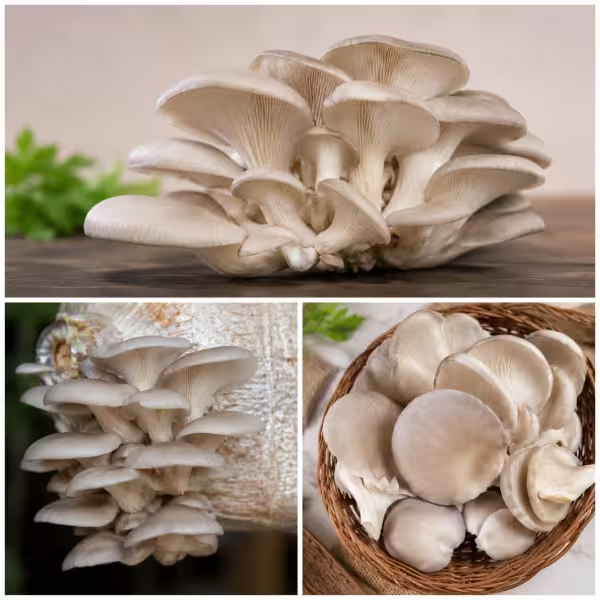
Oyster mushrooms — the primary variety we cultivate — are among the fastest-fruiting and most forgiving mushroom species. The growing cycle from inoculation to first harvest is 3–4 weeks. A single substrate block typically produces 2–3 flushes before it is exhausted.
The yield-to-input ratio is exceptionally favourable. A single kilogram of substrate typically produces 800g–1.2kg of fresh mushrooms across its growing cycle — a biological efficiency that no conventional vegetable crop approaches.
The fast feedback cycle is a psychological as much as an economic advantage. For first-time growers accustomed to seasonal agricultural rhythms, seeing a successful harvest within a month builds confidence and commitment to the programme rapidly.
In the agricultural calendar of eastern Uttar Pradesh, there are significant seasonal income gaps — periods between crop cycles when rural households have no agricultural income. Mushroom cultivation fills these gaps. Because it is done indoors in a controlled environment, it is not subject to monsoon timing, winter frost, or summer heat in the way that field crops are.
This means a woman enrolled in our programme can, in principle, maintain continuous production and income throughout the year. The practical implication for household financial stability — particularly in the lean months of summer — is significant.
Year-round production also means year-round supply to our processing operations, which is essential for the viability of our value-added products business and the sustainability of the guaranteed buyback commitment.
Beyond the economic and environmental case, mushrooms are a high-value food. Rich in protein, low in calories, and packed with micronutrients — they represent an important addition to the diet of rural households who often face protein deficiency.

Up to 35% protein by dry weight — rare for a plant-based food source

One of the few non-animal sources of Vitamin D — critical for communities with limited dietary diversity

High satiety relative to caloric content — nutritionally dense without contributing to obesity

Immune-supporting compounds with documented anti-inflammatory properties — the basis of our functional products
The argument for mushroom cultivation as a vehicle for rural women’s empowerment is agricultural, economic, environmental, and social all at once. If you’re looking for a programme that’s credible on all those dimensions — we’d like to hear from you.